Show, Don't Tell: How Mike Judge Lets the Camera Speak in Extract
There's a reason Extract lingers with you after the credits roll, even if you can't immediately put your finger on why. Sure, the jokes land. The performances are solid. But there's something else working underneath all of it — something quieter, more persistent. Mike Judge is using the camera itself as a storytelling instrument, and if you haven't gone back to look at what he's actually doing visually, you're only getting half the movie.
Let's dig in.
The Factory as a Living, Breathing Trap
From the very first time we see Reynold's Extract — Joel Miller's flavor extract bottling plant — the production design is doing serious heavy lifting. This isn't a sleek, aspirational workspace. It's cluttered, fluorescent-lit, and relentlessly beige. The kind of place where ambition goes to get worn down into something manageable.
Judge and his production team made deliberate choices to give the factory a low ceiling, both literally and figuratively. The camera frequently frames Joel in the middle distance, surrounded by equipment and employees, with very little open space around him. He's technically the boss, technically the guy in charge — but the visual language keeps insisting that he's just as boxed in as everyone else on that floor.
That's not an accident. That's a directorial argument.
When Joel walks through the plant, the camera rarely elevates to give him a position of authority. He doesn't get the heroic low-angle shot that would signal he's the king of his domain. Instead, he's shot at eye level or slightly above, which subtly flattens his status and keeps him visually anchored to the same plane as the workers he manages. The factory doesn't recognize the hierarchy Joel has built in his head, and neither does the camera.
Lighting That Tells the Truth
One of the most underappreciated elements of Extract's visual design is how differently the film lights its interior spaces versus the outside world.
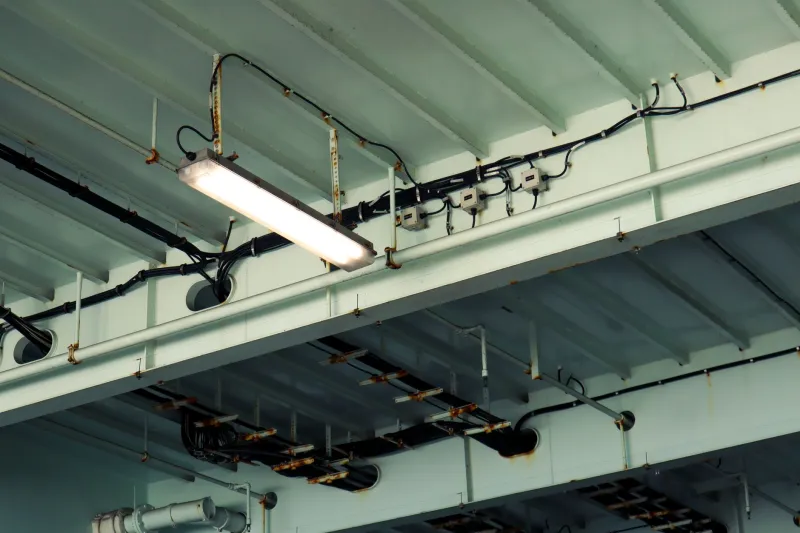
The factory scenes are bathed in that cold, institutional fluorescent glow — the kind of light that makes everybody look a little tired and a little defeated. It's the lighting equivalent of a long Monday afternoon. Joel's house isn't exactly warm either, but there's a different quality to those scenes, a slightly more natural palette that suggests the possibility of life outside work, even if that life isn't going particularly well.
What's interesting is that the film doesn't use lighting to glamorize anything. There's no aspirational warmth waiting for Joel at home, no golden-hour promise of a better life just around the corner. The lighting throughout Extract operates in a kind of muted, realistic register that mirrors Joel's emotional state — not in crisis, not in joy, just... going through the motions. The visual world of the film reflects the psychological world of its protagonist with remarkable consistency.
Camera Placement and the Architecture of Isolation
Judge has always been interested in the way physical spaces shape human behavior — you can see it all the way back in Office Space, where the cubicle farm becomes a metaphor for bureaucratic suffocation. In Extract, he's doing something similar but with more visual sophistication.
Watch how Joel is framed in scenes where he's technically surrounded by people. At the bar with Dean, at the factory with his employees, even at home with his wife Suzie — Joel is almost never shot in a way that suggests genuine connection. There's frequently something between him and the other characters: a bar counter, a piece of equipment, the width of a couch cushion. The blocking and camera placement consistently reinforce the idea that Joel exists in a kind of invisible bubble, close to people but not really with them.
This is visual storytelling doing the work that lesser films would assign to a therapy-scene monologue. We don't need Joel to explain that he feels alone because we can see it in the geometry of every shot.
The Driveway: Extract's Most Quietly Devastating Location
If the factory is where Joel is trapped professionally, his driveway is where he's trapped personally. The recurring bit — Joel pulling into his own driveway, spotting his neighbor Nathan, then desperately trying to duck inside before getting cornered — is played for laughs. And it works as comedy. But look at what Judge is actually doing with the camera in those sequences.
The driveway is shot with a kind of wide, exposed framing that makes it feel like a no-man's-land. There's no cover, no escape route. Joel is caught in open space, visible, vulnerable, unable to retreat to either the professional world of the factory or the private world of his house. It's liminal territory, and the camera treats it that way — bright, flat, inescapable.
That recurring visual gag is really a recurring visual argument: Joel has built a life where he doesn't feel at home anywhere.
What the Production Design Reveals About Joel's Ambitions
There's a telling contrast embedded in the film's production design that doesn't get nearly enough attention. The extract factory, for all its ordinariness, was built by Joel. It's his creation, his achievement. But the way Judge shoots it, the place never feels like a monument to success — it feels like a machine that has absorbed its creator.
Joel's office within the factory is a particularly sharp piece of visual storytelling. It's glass-walled, which sounds like it should feel open and commanding, but instead it just means everyone can see Joel at all times. He has no privacy in his own domain. The transparency that should signal confidence and accessibility instead reads as exposure. Joel is on display, observable, with nowhere to hide.
Compare that to how Dean's bar is shot — dim, close, conspiratorial. That's where the bad ideas get hatched, and the camera knows it.
Extracting the Subtext
What makes Extract's visual storytelling so effective is that it never calls attention to itself. This isn't a film that wants you to notice the cinematography. It wants the cinematography to burrow under your skin and make you feel something you can't quite articulate — the low-grade claustrophobia of a life that looks fine from the outside and feels like a slow squeeze from the inside.
Mike Judge built a whole career on finding the comedy in that specific kind of American experience. But in Extract, more than in any of his other work, he trusts the image to carry the weight. The dialogue is funny. The performances are grounded. But the camera — quiet, deliberate, and a little merciless — is the thing that makes it all stick.
Next time you watch it, pay attention to where Judge puts the lens. The movie's real argument isn't in what the characters say. It's in what the frame refuses to let them escape.